Publishing Details
Contact & Outreach
About This Podcast
Podcasting 2.0 Features
Explore Statistics
Recent Episodes
Episode 90 — Prevent Shadow AI: Sanctioned Tools, Usage Rules, and Enforcement Patterns
This episode focuses on preventing shadow AI as a governance and data protection requirement, because SecAI+ expects you to control unapproved tools that employees adopt for convenience, often…
Episode 89 — Apply Responsible AI Principles: Fairness, Transparency, and Explainability Choices
This episode teaches responsible AI principles in an exam-ready, security-relevant way, because SecAI+ expects you to translate fairness, transparency, and explainability into practical choices that…
Episode 88 — Define AI Security Responsibilities: Owners, Approvers, Builders, and Auditors
This episode focuses on defining responsibilities clearly, because SecAI+ scenarios often reveal failures caused by vague ownership, where everyone assumes someone else handled security review, data…
Episode 87 — Build AI Governance Structures: Policies, Roles, and a Working Operating Model
This episode explains AI governance as an operating model that makes security and compliance achievable at scale, because SecAI+ expects you to choose governance structures that produce consistent…
Episode 86 — Manage CI/CD With AI Assistants: Secure Pipelines, Tests, and Change Control
This episode teaches how AI assistants fit into CI/CD without weakening security, because SecAI+ scenarios often involve AI-generated code, AI-suggested pipeline changes, or automated remediation…
Episode 85 — Apply Safe Automation: Low-Code Workflows With Guardrails and Auditability
This episode focuses on safe automation using low-code workflows, because SecAI+ expects you to recognize that automation reduces toil but can also amplify errors and create new abuse paths when…
Episode 84 — Recognize AI-Assisted Malware Evolution: Obfuscation, Mutation, and Detection Gaps
This episode teaches how AI can accelerate malware evolution by supporting rapid variation, improved obfuscation, and faster iteration on what evades detection, which is a key SecAI+ theme when…
Episode 83 — Track AI-Accelerated Recon: Target Discovery, Enumeration, and Defensive Signals
This episode focuses on how AI accelerates reconnaissance by reducing attacker effort in discovering targets, mapping organizations, and enumerating exposed systems, and how SecAI+ expects you to…
Episode 82 — Counter AI-Scaled Social Engineering: Phishing, Vishing, and Pretext Detection
This episode teaches how AI scales social engineering by making messages more convincing, more personalized, and easier to generate at volume, which is exactly why SecAI+ includes scenarios that test…
Episode 81 — Understand AI-Driven Deepfakes: Impersonation Risk and Verification Countermeasures
This episode explains why AI-driven deepfakes are a security problem, not just a media curiosity, and how SecAI+ expects you to analyze impersonation risk in realistic organizational workflows. You…
Episode 80 — Use AI for Threat Intel: Entity Extraction, Clustering, and Confidence Handling
This episode teaches practical uses of AI in threat intelligence, because SecAI+ expects you to apply AI to messy text and indicator data while still handling uncertainty, provenance, and bias…
Episode 79 — Use AI for Incident Triage: Summaries, Prioritization, and Evidence Integrity
This episode focuses on using AI for incident triage without compromising evidence integrity, because SecAI+ expects you to accelerate understanding while still preserving the chain of custody and…
Episode 78 — Use AI for Detection Engineering: Rules, Correlation, and Noise Reduction
This episode teaches AI-assisted detection engineering in a way that matches SecAI+ expectations, because exam scenarios often involve improving detection coverage and quality while controlling false…
Episode 77 — Use AI for Code Review: Linting, SAST Triage, and False-Positive Control
This episode focuses on using AI to improve code review efficiency without weakening security rigor, because SecAI+ expects you to balance speed gains against the risk of missed findings, noisy…
Episode 76 — Use AI in Secure Coding: Generating Code Without Injecting Vulnerabilities
This episode teaches how to use AI for code generation without turning your SDLC into a vulnerability factory, because SecAI+ expects you to recognize that AI can accelerate delivery while also…
Episode 75 — Reduce Overreliance Risk: Human Verification Loops and Safe Escalation Rules
This episode focuses on overreliance as a real operational hazard, because SecAI+ expects you to design workflows that keep humans in control of high-impact decisions even when AI outputs are fluent,…
Episode 74 — Secure Integrations and Plug-Ins: Trust Boundaries, Validation, and Least Privilege
This episode teaches integration security for AI systems, because SecAI+ scenarios often involve plug-ins, connectors, and third-party services that expand capability while also expanding attack…
Episode 73 — Handle Denial-of-Service Risks: Model DoS, Cost Bombs, and Resilience
This episode focuses on denial-of-service in AI systems, because SecAI+ expects you to defend not only availability, but also cost stability and operational continuity when models can be abused with…
Episode 72 — Prevent Model Theft: Extraction Risks, Query Limits, and Watermark Strategies
This episode teaches model theft as an access and abuse problem, because SecAI+ scenarios often involve attackers trying to replicate a model’s behavior by querying it repeatedly, capturing outputs,…
Episode 71 — Analyze Membership Inference Risks: Privacy Exposure and Defensive Techniques
This episode focuses on membership inference as a practical privacy risk, because SecAI+ expects you to recognize when attackers can probe a model to determine whether a specific record was part of…
Frequently Asked Questions
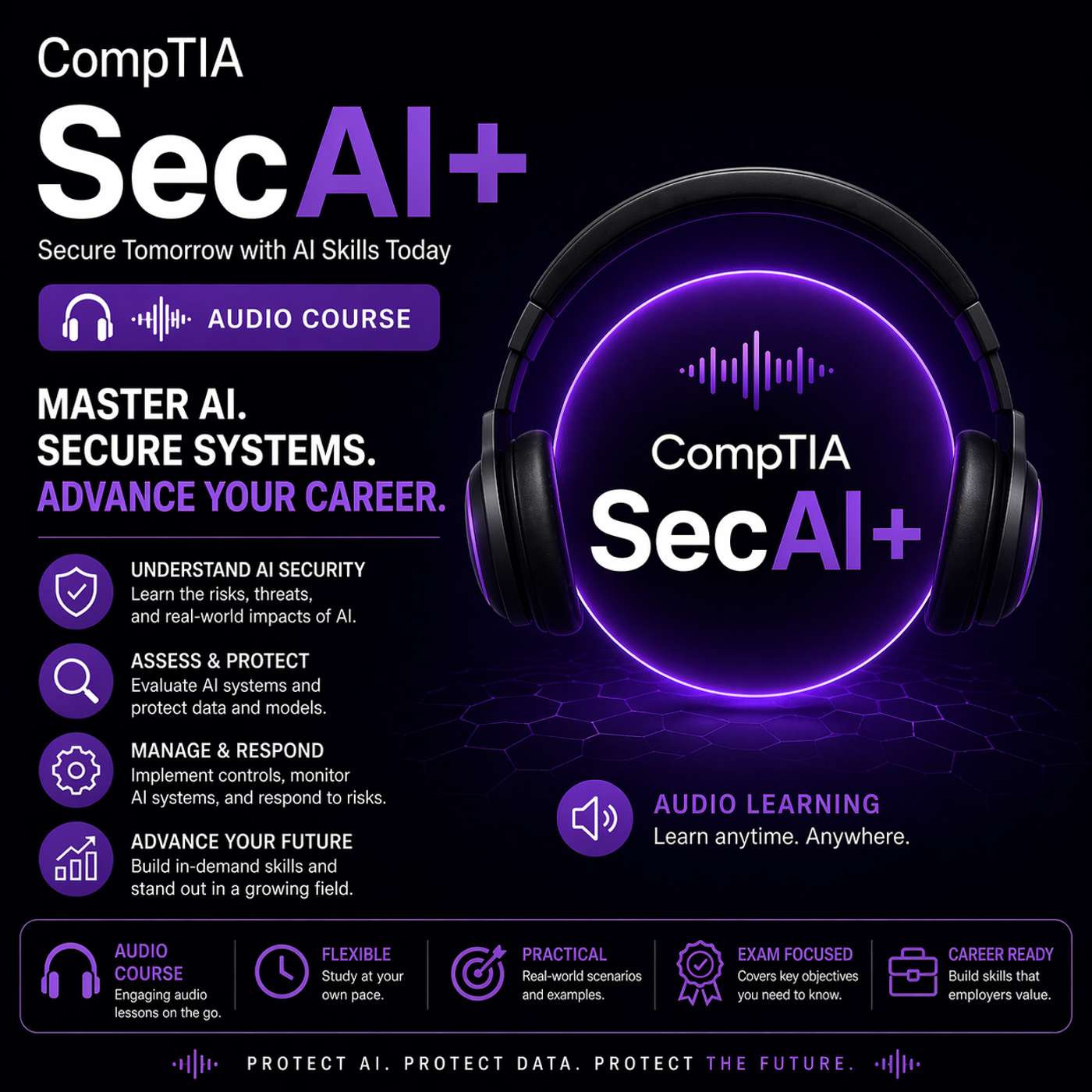
Certified: The CompTIA SecAI+ Audio Course has published 91 episodes since February 2026, covering topics in Courses, Education.
Certified: The CompTIA SecAI+ Audio Course is currently dormant with new episodes hourly. Average episode length is 12m.
Sign up on Grep.FM to access contact details for Certified: The CompTIA SecAI+ Audio Course, including email and social media links.
Similar Podcasts

Data Career Podcast: Helping You Land a Data Analyst Job FAST
Avery Smith - Data Career Coach
213 episodes

Boardroom Governance with Evan Epstein
Evan Epstein
211 episodes

Machine Learning Guide
OCDevel
60 episodes

Technology Tap: CompTIA Study Guide
Juan Rodriguez - CompTIA Exam Prep Professor
138 episodes
Apple @ Work
9to5Mac
100 episodes

Women Leaders on the Move - HerCsuite® Radio
Natalie Benamou, Host and HerCsuite® Founder, C-suite leader
270 episodes