Publishing Details
Contact & Outreach
About This Podcast
Podcasting 2.0 Features
Explore Statistics
Recent Episodes
Episode 88 — Prepare for Incidents: Draft and Update IR Documentation That OT Can Use
This episode teaches how to prepare for incidents by drafting and maintaining IR documentation that OT teams can actually use during real events, where time pressure and safety constraints punish…
Episode 87 — Execute Escalation and Notification: Internal, Government, and Regulator Expectations
This episode explains escalation and notification as disciplined processes that protect safety, preserve credibility, and reduce legal and regulatory risk, because delayed or inconsistent…
Episode 86 — Plan Mutual Aid and Retainers: ISACs, Peer Support, and IRR Readiness
This episode teaches how to plan mutual aid and retainers so OT incident response readiness is real, not theoretical, especially when specialized expertise and vendor knowledge may be required…
Episode 85 — Coordinate IT and OT During Incidents: Nuances, Authority, and Safety Priorities
This episode explains how to coordinate IT and OT during incidents without letting either side accidentally increase risk, a common scenario theme where the “wrong” answer is a technically reasonable…
Episode 84 — Address Overarching OT Incident Considerations: Cyber, Physical, Crisis, and Facilities
This episode teaches the overarching considerations that make OT incident response different, because OT incidents often blend cyber events with physical realities, crisis management demands, and…
Episode 83 — Describe OT Incident Management Frameworks: PICERL and ICS4ICS With Clear Roles
This episode explains how OT incident management frameworks provide structured response discipline when safety and uptime are at stake, and why SecOT+ scenarios often reward the answer that follows a…
Episode 82 — Apply a Collection Management Framework: What to Collect, How Often, and Why
This episode teaches how to apply a collection management framework so OT security data collection is purposeful, sustainable, and aligned to operational constraints rather than being an endless hunt…
Episode 81 — Map Assets to a CMDB: Attributes, Relationships, and Drift Control:
This episode explains how to map OT assets into a CMDB in a way that supports security decisions without forcing IT-centric data models that ignore plant reality. You’ll learn which attributes belong…
Episode 80 — Maintain Software Inventory and Map to Hardware: Visibility That Enables Decisions
This episode explains why software inventory in OT must be mapped to hardware reality, because risks often live in firmware versions, installed packages, configuration sets, and vendor toolchains…
Episode 79 — Capture Key Asset Attributes: Identity, Location, Ports, Ownership, Vendor, and Function
This episode teaches which asset attributes matter most for OT security decisions and why capturing the right details prevents wasted effort during audits, patch planning, and incident response.…
Episode 78 — Choose Discovery Methods Carefully: Passive, Active, and Manual Approaches in OT
This episode teaches how to choose asset discovery methods that respect OT safety and reliability constraints, because the wrong discovery approach can disrupt production and destroy trust in the…
Episode 77 — Operationalize Asset Management: Inventory Discovery, Creation, Validation, and Maintenance
This episode explains asset management as a continuous OT security capability, because you cannot govern access, assess risk, or respond confidently if you do not know what exists and what it does.…
Episode 76 — Implement Perimeter Controls: Fences, Barriers, and Access Governance for Facilities
This episode teaches facility perimeter controls as the outermost layer of OT defense, because the easiest attack path is often the one that requires no network sophistication at all. You’ll learn…
Episode 75 — Use Surveillance and Inspection: Walkdowns, Video, Motion Detection, Spectrum Analysis
This episode explains how surveillance and inspection support OT security by providing reality checks that tools alone cannot deliver, especially in environments where visibility gaps and legacy…
Episode 74 — Secure Rooms, Cabinets, and Cabling: IDFs, MDFs, and Exposure Reduction
This episode teaches how to secure critical spaces and infrastructure elements in OT, because many “cyber” compromises become easy when rooms, cabinets, and cabling are treated as mere facilities…
Episode 73 — Apply Physical Security in OT: Badges, Readers, Biometrics, and Turnstiles
This episode explains physical security controls as part of OT security posture, because physical access frequently equals control access when cabinets, ports, and engineering environments are…
Episode 72 — Maintain Interoperability and Simplicity: Compatibility Without Expanding Attack Surface
This episode teaches how to maintain interoperability in OT while keeping designs simple enough to operate reliably, because complexity creates hidden dependencies and workarounds that expand attack…
Episode 71 — Build for Performance, Auditability, and Observability: Trust You Can Prove
This episode explains how OT security designs must preserve performance while also producing auditability and observability that can be demonstrated with evidence, because “we think it’s secure”…
Episode 70 — Engineer Compartmentalization and Criticality: Limiting Blast Radius Without Breaking Control
This episode teaches how to engineer compartmentalization in OT so you can limit blast radius while still preserving the control behaviors operations depend on, a balancing act that shows up…
Episode 69 — Design for Operational Resilience: Endurance, Redundancy, High Availability, Recoverability
This episode explains operational resilience as the ability to endure disruption and recover safely, which is a central OT outcome and a frequent thread in SecOT+ scenarios about outages,…
Frequently Asked Questions
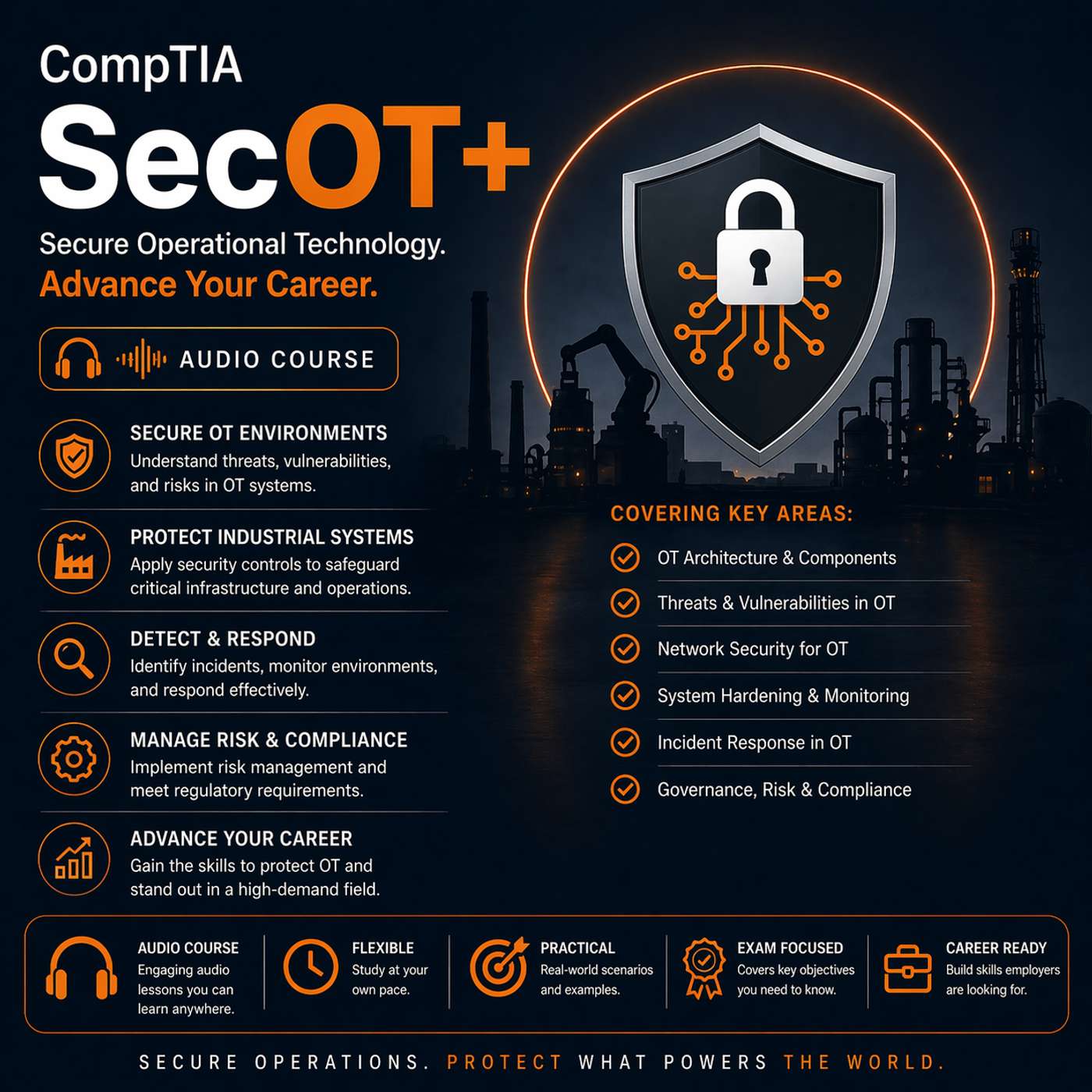
Certified: The CompTIA SecOT+ Audio Course has published 89 episodes since February 2026, covering topics in Courses, Education.
Certified: The CompTIA SecOT+ Audio Course is currently dormant with new episodes hourly. Average episode length is 15m.
Sign up on Grep.FM to access contact details for Certified: The CompTIA SecOT+ Audio Course, including email and social media links.
Similar Podcasts

Data Career Podcast: Helping You Land a Data Analyst Job FAST
Avery Smith - Data Career Coach
213 episodes

Boardroom Governance with Evan Epstein
Evan Epstein
211 episodes

Machine Learning Guide
OCDevel
60 episodes

Technology Tap: CompTIA Study Guide
Juan Rodriguez - CompTIA Exam Prep Professor
138 episodes

Apple @ Work
9to5Mac
100 episodes

Women Leaders on the Move - HerCsuite® Radio
Natalie Benamou, Host and HerCsuite® Founder, C-suite leader
270 episodes